Projects I turned down and what each one taught me
A practical guide to when to turn down a software client, with fictional project scenarios, alternatives and a checklist for saying no respectfully.
On this page 7 sections
This guide was prepared in November 2026. The displayed 10 November 2026 date was requested for the post; it is not its original publication date.
The title describes the topic, but the situations below are fictional examples, not accounts of projects I actually declined. They show how to make the decision without attributing a warning sign or outcome to a real client.
A budget smaller than the requested product#
Imagine a client who wants a school management system covering attendance, fee vouchers, payroll and parent messages. Their available budget covers only a fraction of the work needed to build and support those features responsibly.
A small budget does not make someone a bad client. The question is whether there is a useful first outcome that fits it. For example, could the team build and test a fee-voucher workflow while leaving payroll and messaging out? Put those exclusions in writing and agree on who will provide sample data and approve the result.
If the client needs the entire system at the original price, the gap remains. Decline the full scope rather than promising it and leaving the missing work for later.
Lesson: compare the budget with a defined outcome. A cheaper quote that omits necessary work is not the same as a smaller agreed release.
A deadline nobody can explain#
Another hypothetical client asks for an application in two weeks. There is no agreed scope yet, and a payment integration depends on access from a third party. The client also needs time to review the work, but nobody has named the reviewer.
Ask what makes the date important. An event, a contract or an internal demonstration may have a different minimum requirement. A clickable prototype might be enough for a demonstration; it is not a substitute for a production payment flow.
If a narrower milestone is useful, describe what it includes and what it cannot do. Record the access and review assumptions. If the full product must launch by the fixed date and those conditions cannot be met, say no to that commitment.
Lesson: a deadline is only meaningful when the deliverable and dependencies are clear.
Access to sensitive data without a safe plan#
Imagine being asked to add an AI assistant to a healthcare application, with real patient records supplied before anyone has agreed on permissions, storage or the intended use. The responsible answer may be to pause, clarify the data flow and involve someone qualified to assess the risks.
A test with synthetic or properly de-identified data could help explore the interface, if the client agrees. That does not settle every privacy or security question for production. If the work exceeds the team’s competence, requires access the client cannot authorise, or asks you to bypass safeguards, decline or refer the client to an appropriately qualified team.
Lesson: an attractive project still needs a plan for access, security and ownership. Do not accept risk simply because the implementation sounds interesting.
Unclear decisions and changing terms#
A project can begin with reasonable uncertainty. The concern is what happens when you try to resolve it. If nobody can approve the scope, there is no way to tell when the work is finished. If payment terms keep changing, the team cannot plan around the agreement.
Ask for one decision-maker or an agreed approval process. Describe acceptance criteria for each milestone and put payment terms in writing before starting. If the client is still learning what they need, propose a bounded discovery phase with a clear output, fee and decision point.
If the parties cannot agree on those basics, do not start on the assumption that they will sort themselves out later. Declining an unclear engagement is different from accusing the client of acting in bad faith.
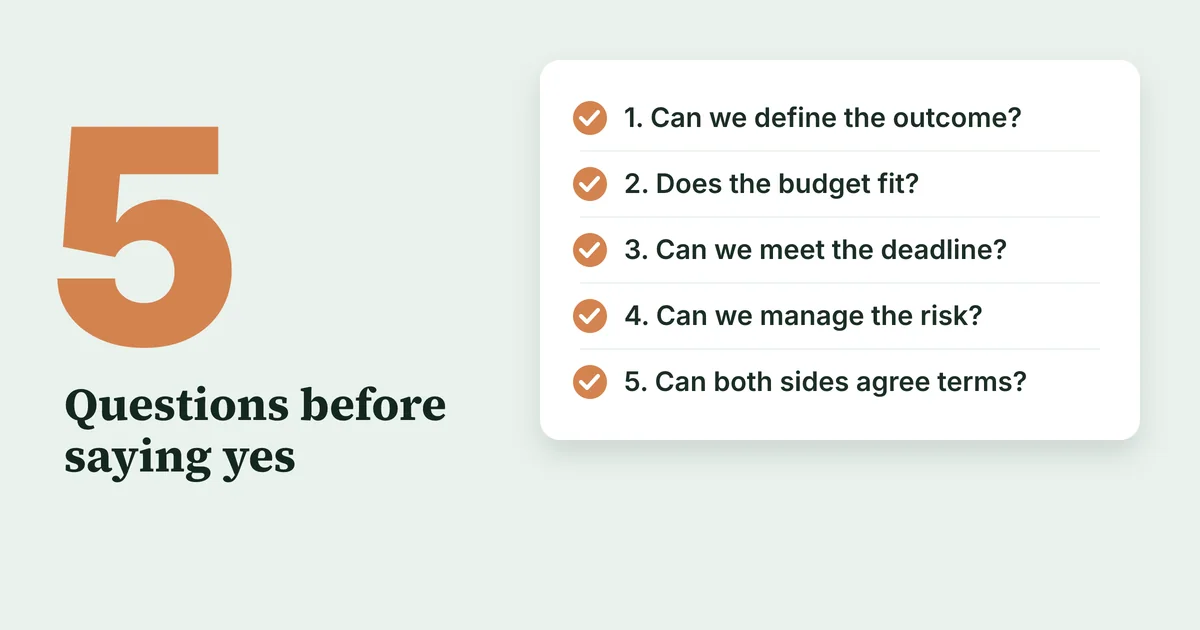
Five questions before saying yes#
Use these questions together. A single unanswered question can be a reason to pause and investigate, not an automatic reason to reject the client.
| Question | What to establish |
|---|---|
| Can we define the outcome? | A first user, deliverable, exclusions and acceptance criteria |
| Does the budget fit? | Whether it covers the agreed work, including necessary testing |
| Can we meet the deadline? | Team capacity, dependencies and time for review |
| Can we manage the risk? | Data access, security needs and the skills available |
| Can both sides agree terms? | Decision-maker, payment milestones, ownership and handover |
Download the software client decision checklist for a version you can fill in before a proposal. If there are unknowns, record who will answer them and by when. Proceed, re-scope or decline after that discussion.
How to say no without making it personal#
Keep the message short, specific and honest. Here are suggested templates, not transcripts of real conversations:
Thank you for sharing the project. I don’t think we can deliver the full scope within the budget you’ve set, so I’m going to decline the project as currently defined. If useful, I can outline a smaller first phase for you to consider.
Only offer that smaller phase if you are prepared to scope it. If the reason is capacity, say so instead:
Thank you for considering us. We don’t have the capacity to deliver this responsibly by your deadline, so we won’t submit a proposal. I hope you find the right team for it.
You can offer an introduction when you know someone suitable and have their permission. Avoid sharing the prospective client’s confidential details without consent. You do not need a long explanation or a promise to become available later.
Leave a path back when the conditions change#
A no can be specific to a scope or date. If the client later secures a larger budget, changes the deadline or appoints a decision-maker, review the project again against the current facts. Do not reserve capacity or imply acceptance unless both sides agree to it.
For projects that do proceed, the next step is a written scope that says what the first user can complete. The first-call checklist can help establish that before a price becomes a promise.
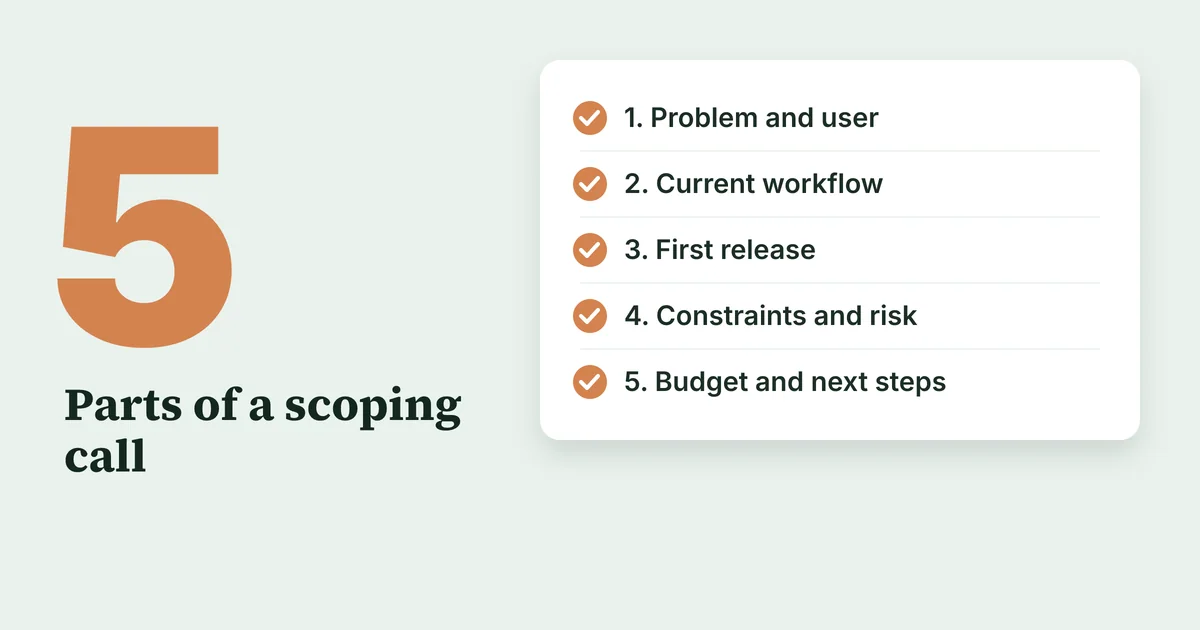 Founder · 8 min readHow I scope an MVP in one call: my question listA practical first-call checklist for scoping an MVP, from the user's problem and core workflow to risks, estimates and a one-page proposal.
Questions readers ask
When should a developer turn down a software client?
Consider declining when you cannot agree on a safe scope, workable terms or a realistic deadline, even after discussing alternatives. Decline requests that you cannot deliver responsibly or that conflict with your standards.
Should a small budget mean rejecting a software project?
Not automatically. Check whether a smaller complete outcome or a discovery phase fits the budget. If the required work cannot be done responsibly for the available amount, explain the gap and decline.
How do you politely decline a software project?
Thank the client, give a brief honest reason and state the decision clearly. Offer a smaller scope or a referral only if it is a genuine fit and you have permission to make the introduction.