Distribution beats features: notes from cold-calling schools
What cold-calling school principals taught me about selling software to schools: the script, the numbers, and why a rejected call beats a landing page.
On this page 5 sections
After the POS, I promised myself the next product would start with customers, not code. For Oxygen LMS, an operating system for schools, that meant doing the thing most engineers avoid: picking up the phone.
Why the phone#
Schools in Pakistan don’t discover software through Product Hunt or Google Ads. Decisions are made by a principal or an owner who is busy, cautious and gets pitched by a lot of people. A landing page doesn’t reach them. A short, respectful conversation sometimes does.
The process#
- Week 1
Build a list
A spreadsheet of private schools in one city: name, phone, size, fee range, who decides.
- Week 1–2
Write a 20-second opener
Who I am, the one problem I’m solving, and a small ask. No feature list.
- Week 2–4
Call every afternoon
A fixed block every day. Log every call in the sheet: outcome, objection, next step.
- Week 4
Visit the warm ones
Sit in the office, watch how attendance and fees actually work, and show a rough demo.
The opener#
The first version of my script was a feature list. It failed. The version that worked was short and about their problem:
“Assalam o Alaikum, I’m Gulzaib, a software engineer in Islamabad. I’m building a simple system for fee collection and attendance for schools like yours, and I’m speaking to principals before I finish it. Could I ask you two quick questions about how you handle fees today?”
Asking for advice instead of a sale changes the tone of the whole call. People like being asked about their work.
What the calls taught me#
Most calls go nowhere. That’s fine. The value is in the pattern across dozens of them.
- The pain wasn’t where I expected. I thought schools wanted smart timetables. What came up again and again was fee collection and parent communication (what schools actually pay for).
- The user isn’t the buyer. Teachers use the system, the owner pays for it, and the admin clerk can quietly kill it. You need all three.
- Simplicity is a feature. “My staff can’t use complicated software” was one of the most common objections. More on that in the next post.
- Trust is local. “Which other schools use it?” came up on almost every positive call. Your first three customers are your marketing.
Every rejected call is a free lesson in positioning. A landing page with no traffic teaches you nothing.
The founder’s math#
Distribution is a numbers game, so treat it like one. The exact numbers vary by market. The shape of the funnel doesn’t.
| Stage | What it means | What to measure |
|---|---|---|
| Dial | You called | Calls per day |
| Connect | You reached the decision maker | Connect rate |
| Conversation | They gave you two minutes | Conversations per week |
| Visit or demo | They agreed to meet | Demo rate |
| Pilot | They agreed to try it | Pilots, and why the others said no |
For engineers who hate selling#
I get it. I’m an engineer too. Three things made it bearable:
- Time-box it. One hour a day, then back to code. You don’t need to become a salesperson. You just need to learn.
- Use a script, then drop it. The script gets you through the first ten calls. After that, you’ll know what to say.
- Remember you’re helping. If the product genuinely solves their problem, telling them about it is a service.
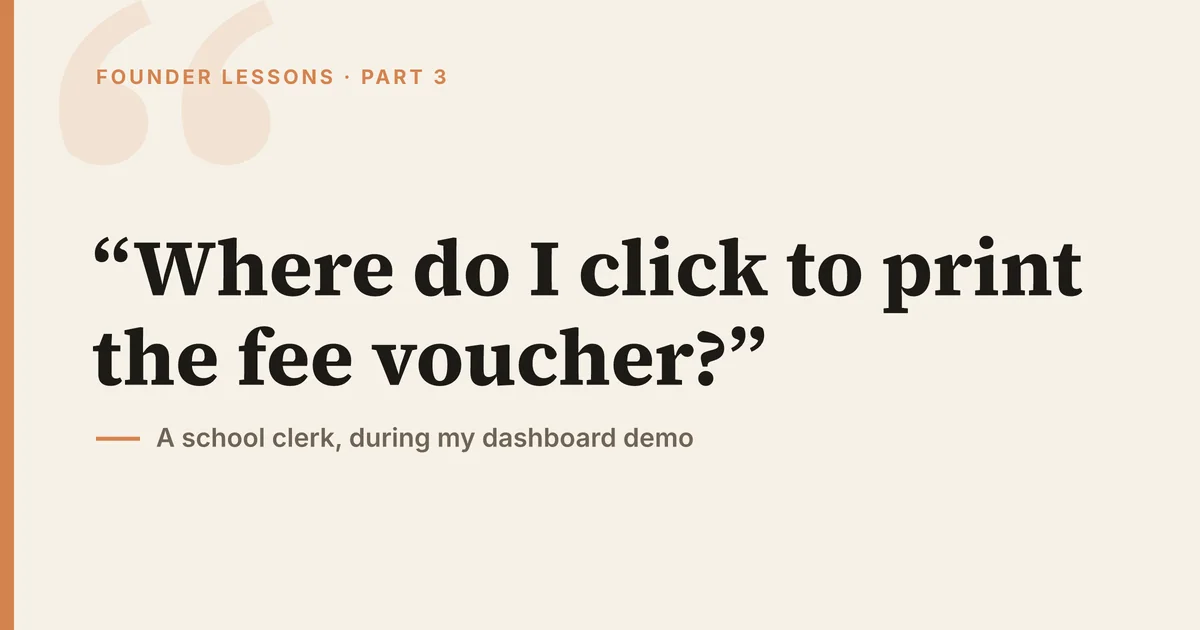 Founder · 2 min readSimple wins: designing for the least technical user in the roomPeople pick software they enjoy over the longest feature list. A practical guide to designing SaaS for users who would rather not use software at all.