Designing the database for a school ERP
A tested MySQL schema for a school ERP: dated enrolments for promotions, composite tenant keys and an append-only fee ledger in paisa. With Laravel migration.
On this page 8 sections
I first sketched this schema in May 2026, a few months into building Oxygen LMS. In November I wrote it up, tested every rule on MySQL 8.0 and 8.4, and added the sources.
Most ER diagrams for a “school management system” put class_id on the students table. That works until the school promotes everyone at the end of the year. You update the column, and last year’s class lists, attendance registers and result sheets now point at the wrong class.
This is the schema I’d start a school ERP with on Laravel and MySQL, for private schools in Pakistan. It goes with two other posts: the multi-tenant Laravel setup covers the application side of keeping schools apart, and what schools pay for explains why the fee tables get the most care. It’s a cut-down, tested design for this post, not a dump of a production database.
What tables does a school ERP need?#
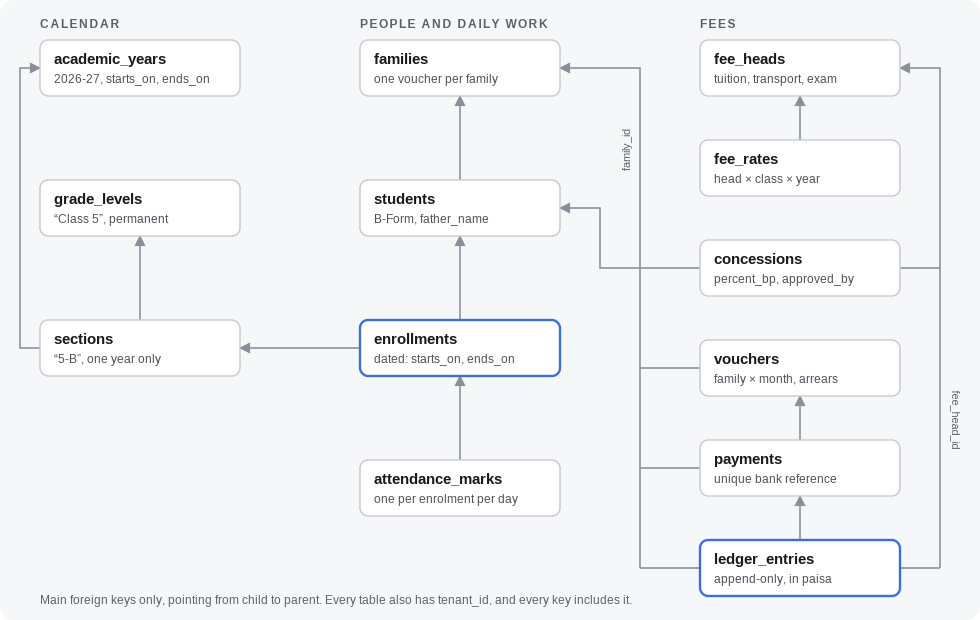
Fourteen tables cover the daily work. Each one has a clear answer to “what is one row?”:
| Group | Table | One row is |
|---|---|---|
| Tenancy | tenants | A school |
| Calendar | academic_years | A session, e.g. 2026-27 |
grade_levels | “Class 5”, permanent | |
sections | “5-B in 2026-27”, one year only | |
| People | families | The household that gets one voucher |
students | A child’s identity, nothing about class | |
enrollments | A student in a section, from a date to a date | |
| Daily work | attendance_marks | One enrolment, one day |
| Fees | fee_heads | Tuition, Transport Route 3, Exam fee |
fee_rates | One head for one class in one year | |
concessions | A sibling, staff or scholarship discount | |
vouchers | One family, one month | |
payments | Money received, with the bank reference | |
ledger_entries | Every rupee owed or paid | |
| Reports | family_balances, section_rosters | Views, not tables |
If you can’t say what one row of a table means in a few words, the table is usually two tables.
Why shouldn’t students have a class_id column?#
Because a class is something a student is in for a while, and the database needs to remember the whiles.
Split it into three parts. grade_levels holds “Class 5”, which exists every year. sections holds “5-B in 2026-27”, created fresh each session. enrollments links a student to a section with dates:
CREATE TABLE enrollments (
  id              BIGINT UNSIGNED AUTO_INCREMENT PRIMARY KEY,
  tenant_id       BIGINT UNSIGNED NOT NULL,
  student_id      BIGINT UNSIGNED NOT NULL,
  section_id      BIGINT UNSIGNED NOT NULL,
  starts_on       DATE NOT NULL,
  ends_on         DATE NULL,                            -- NULL = current
  end_reason      VARCHAR(12) NULL,
  open_student_id BIGINT UNSIGNED AS (IF(ends_on IS NULL, student_id, NULL)) VIRTUAL,
  UNIQUE KEY enrollments_tenant_id (tenant_id, id),
  KEY enrollments_section (tenant_id, section_id, ends_on),
  CONSTRAINT enrollments_reason CHECK ((ends_on IS NULL) = (end_reason IS NULL)),
  UNIQUE KEY enrollments_one_open (tenant_id, open_student_id)
  -- plus the date check, the reason values and two composite foreign keys
);
A student should be in exactly one section at a time. PostgreSQL can enforce that with an exclusion constraint on a date range [7]. MySQL has nothing like it, so the schema uses a generated column instead.
open_student_id holds the student’s id while the row is open and NULL once it closes. A unique index allows any number of NULL values [2], so a student can have ten closed rows but only one open one. Try to enrol Ali in a second section without closing the first and MySQL refuses with error 1062.
The CHECK on line 12 says a row has an end reason exactly when it has an end date. MySQL 8.0.16 and later enforce CHECK constraints, though they can’t call NOW() or look at other tables [1]. Keep them to rules about the row itself.
Attendance then hangs off the enrolment, not the student. A mark for 14 October belongs to “Ali in 5-B, 2026-27”, so it stays with the right register even after he moves on.
How does year-end promotion work?#
Promotion becomes one update and one insert. The update only fills in end dates, so no row ever loses the class it recorded.
Don’t hard-code when the year starts. Punjab’s 2026 session began on 1 April [3], and a school running another calendar will have different dates, so academic_years stores starts_on and ends_on as data.
Create next year’s sections
Add the
2027-28academic year and its sections (“6-B”, and so on). Last year’s sections stay as they are.Close this year’s rows with a reason
Students who repeat a class get
end_reason = 'retained'and a new row in the same grade next year. Everyone else in the section is promoted:START TRANSACTION; UPDATE enrollments SET ends_on = '2027-03-31', end_reason = 'promoted' WHERE tenant_id = 1 AND section_id = 2 AND ends_on IS NULL; INSERT INTO enrollments (tenant_id, student_id, section_id, starts_on) SELECT tenant_id, student_id, 5, '2027-04-01' FROM enrollments WHERE tenant_id = 1 AND section_id = 2 AND ends_on = '2027-03-31' AND end_reason = 'promoted'; COMMIT;Check the history
Ali now has three rows: 4-A (promoted), 5-B (promoted) and 6-B (open). The
section_rostersview still prints the 2026-27 list for 5-B with him on it.
The order matters. Closing first frees the “one open row” slot, so the insert can’t collide with it.
How do you stop one school seeing another school’s data?#
The multi-tenant post puts a global scope on every model, which filters queries by tenant_id. That protects reads. It doesn’t stop a bad write, such as a job that saves School A’s enrolment with School B’s section id. A plain foreign key on section_id is happy with that, because the section exists.
Composite keys close the gap. Each parent table gets UNIQUE (tenant_id, id), and each child points at both columns:
CONSTRAINT enrollments_section
  FOREIGN KEY (tenant_id, section_id) REFERENCES sections (tenant_id, id)
Now a row can only reference a parent from its own school, and the cross-school write fails with error 1452. The cost is one extra unique index per parent table, which the (tenant_id, …) indexes from the earlier post mostly cover anyway.
Laravel’s schema builder handles all of this except the CHECK constraints:
$table->unsignedBigInteger('open_student_id')
    ->nullable()
    ->virtualAs('IF(ends_on IS NULL, student_id, NULL)');
$table->unique(['tenant_id', 'open_student_id'], 'enrollments_one_open');

$table->unique(['tenant_id', 'id']);
$table->foreign(['tenant_id', 'student_id'])->references(['tenant_id', 'id'])->on('students');
$table->foreign(['tenant_id', 'section_id'])->references(['tenant_id', 'id'])->on('sections');

// after Schema::create, since the builder has no CHECK constraints:
DB::statement('ALTER TABLE enrollments ADD CONSTRAINT enrollments_reason
    CHECK ((ends_on IS NULL) = (end_reason IS NULL))');
How should a school ERP store fees?#
As integers, in a ledger that only grows.
Paisa, in BIGINT. Fees are whole rupees, but a 5% late fine on Rs 13,550 is Rs 677.50, and bank files report paisa. FLOAT can’t hold most decimal fractions exactly, so totals drift. Integer paisa never drifts, and DIV 100 turns it back into rupees for printing. Discounts are stored in basis points (1000 = 10%) for the same reason.
Rates per year. fee_rates has one row per fee head, class and academic year, enforced by a unique key. In Islamabad, PEIRA’s rules forbid raising fees during the session [4], so the app never edits a running year’s rate. Next year’s rates are new rows, and old vouchers can always be explained.
A ledger, not a balance column. Every charge, discount, fine and payment is one row in ledger_entries. Charges are positive and payments negative, and a CHECK enforces the sign for each type. Two triggers reject UPDATE and DELETE, so a wrong charge is fixed with a reversal row that points at it. A unique key on reverses_id stops anyone reversing the same row twice.
Here is the family from the fee voucher post, Ali and Sara, through two months:
| Month | Ledger rows | Rs |
|---|---|---|
| April | Tuition × 2, sibling discount, transport | 11,550 |
| April | 1Bill payment, TXN-88231 | −10,350 |
| Balance | 1,200 | |
| May | Tuition × 2, sibling discount, transport, exam fee | 12,350 |
| May voucher: arrears 1,200 + charges 12,350 | 13,550 |
That matches the voucher in the earlier post to the rupee, and the test suite checks it.
Two more unique keys matter. vouchers allows one live voucher per family per month, using the same generated-column trick as enrolments, so a cancelled voucher can be replaced but never duplicated. payments has a unique key on the method and bank reference, so importing the same 1Bill file twice can’t record a payment twice.
What should a student record hold in Pakistan?#
Identity, and nothing that changes each year. Two Pakistan-specific fields matter.
The B-Form number. NADRA issues the Child Registration Certificate, the B-Form, to children under 18 [5]. Store its 13 digits without dashes, with a CHECK on the format and a unique key per school. It’s nullable, because some children arrive without one.
Names as NADRA has them. Since September 2026, FBISE pulls a candidate’s name, father’s name and date of birth for board registration straight from NADRA’s records [6]. A name typed differently at admission turns into a correction years later, at registration time. So students has father_name and date_of_birth as required columns, and admission staff copy them exactly from the B-Form.
What’s left out?#
Enough to fill later posts. The same patterns carry over:
- Exams and marks hang off
enrollments, like attendance, so a result always belongs to the class the student was in. - Guardians.
familiesholds one guardian and phone. A real school needs several contacts per family, with a flag for who gets the fee SMS. - Staff, HR and payroll are their own tables with the same composite keys.
- An audit log for who changed what, outside the ledger, which already records itself.
How was this tested?#
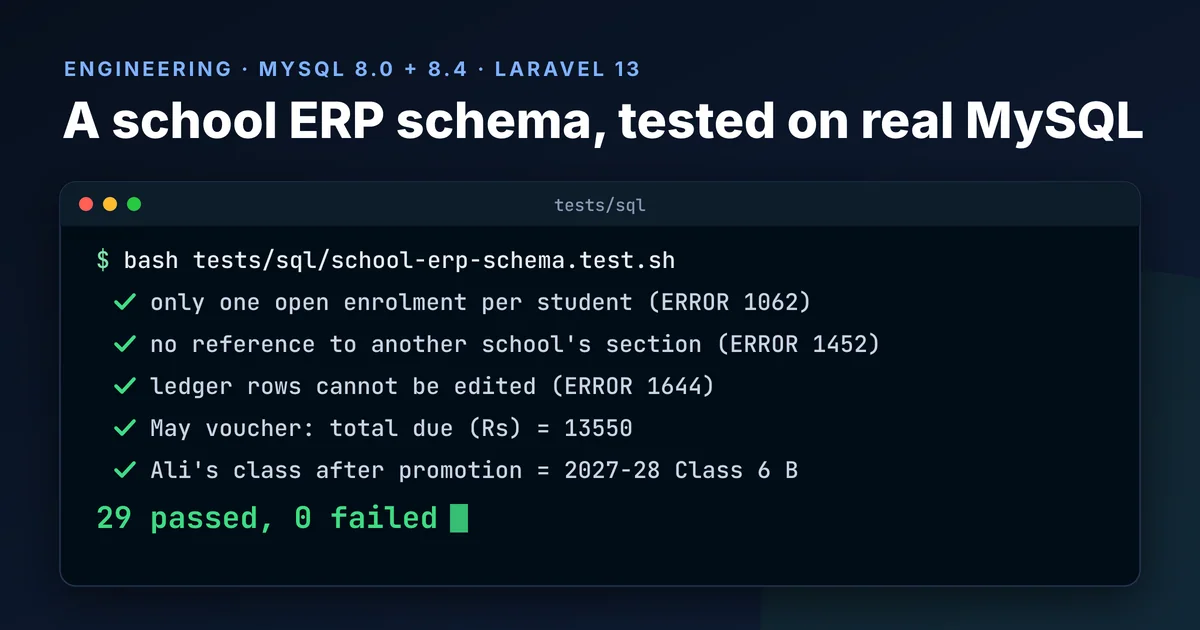
On GitHub Actions, every time the SQL changes. The SQL examples workflow loads the schema into MySQL 8.0 and 8.4, seeds two schools and Ali’s family, and runs 29 checks. A second job copies the migration into a fresh Laravel 13 app and runs it. Some of the rules it confirms:
| Attempt | MySQL says |
|---|---|
| Enrol a student in a second section | Error 1062, duplicate on enrollments_one_open |
| Point at another school’s section | Error 1452, foreign key fails |
| Close an enrolment without a reason | Error 3819, check constraint violated |
| Edit or delete a ledger row | Error 1644, “append-only: add a reversal instead” |
| Import the same 1Bill transaction twice | Error 1062 |
| Enter a B-Form number with a letter in it | Error 3819 |
Download the file, run it in an empty database, and try to break it.
 Engineering · 7 min readMulti-tenant Laravel SaaS: the architecture I actually useSingle database or one per tenant? A production-tested multi-tenant setup for Laravel SaaS: global scopes, tenant resolution, queues and the mistakes to avoid.
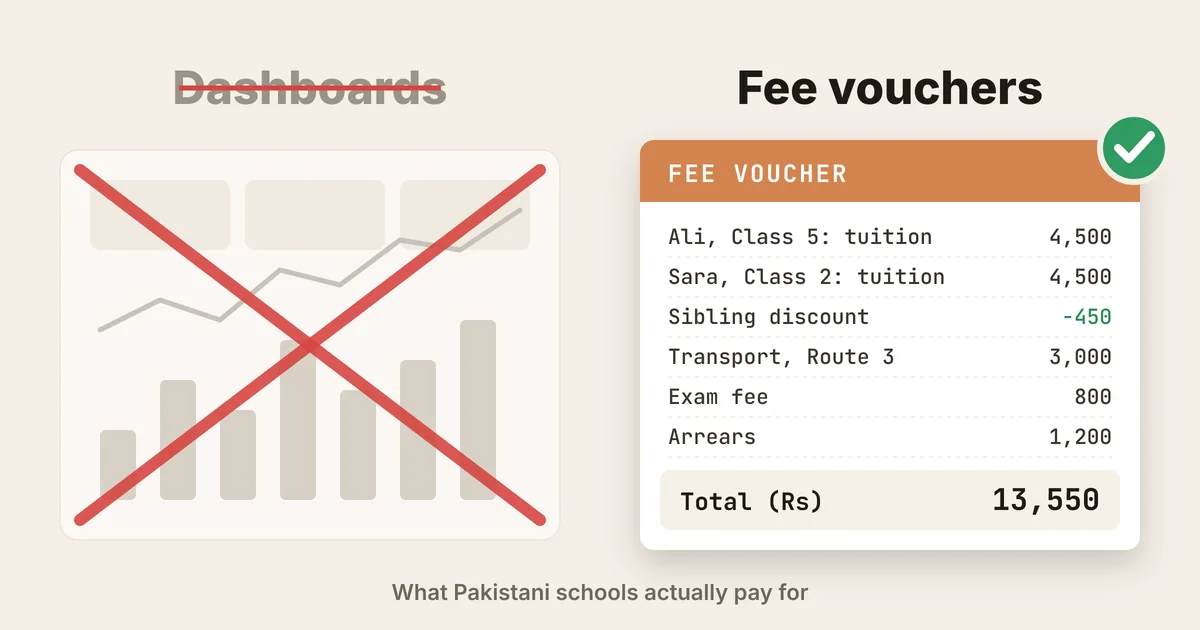 Founder · 5 min readFee vouchers, not dashboards: what schools pay forWhat Pakistani private schools asked for when I pitched school software: fee vouchers that follow their rules, a defaulter list they trust and Urdu SMS.
Questions readers ask
What tables does a school management system database need?
At the core: tenants (schools), academic years, grade levels, sections per year, families, students, enrolments, attendance, fee heads, fee rates, concessions, vouchers, payments and a fee ledger. Exams, staff and timetables hang off the same tables later. The key one is enrolments, which links a student to a section for a dated period.
How do you store a student's class history in a database?
Keep the class off the students table. Each academic year gets its own section rows, and an enrolments table links a student to a section with a start date, an end date and a reason (promoted, retained, transferred). Promotion closes one row and opens another, so every past class list stays correct.
How should a school ERP store fees and money?
Store amounts as integers in the smallest unit (paisa for rupees), never FLOAT. Record every charge, discount and payment as its own row in an append-only ledger, fix mistakes with a reversing row, and treat arrears as the ledger balance printed on the next voucher rather than as a new charge.
References
- Oracle. MySQL 8.4 Reference Manual: CHECK Constraints, 2026.
- Oracle. MySQL 8.4 Reference Manual: CREATE INDEX Statement, 2026.
- The Express Tribune. Punjab revises school admissions policy, updates syllabus and textbooks for 2026, 2025.
- Dawn. Peira directs private schools not to increase fees by more than 5pc, 2021.
- NADRA. Juvenile Card / Child Registration Certificate (CRC), 2026.
- NADRA. NADRA and FBISE Sign Agreement to Integrate Student Registration and Educational Certificates System, 2026.
- PlanSmith. School management system database design, 2026.