Multi-tenant Laravel SaaS: the architecture I actually use
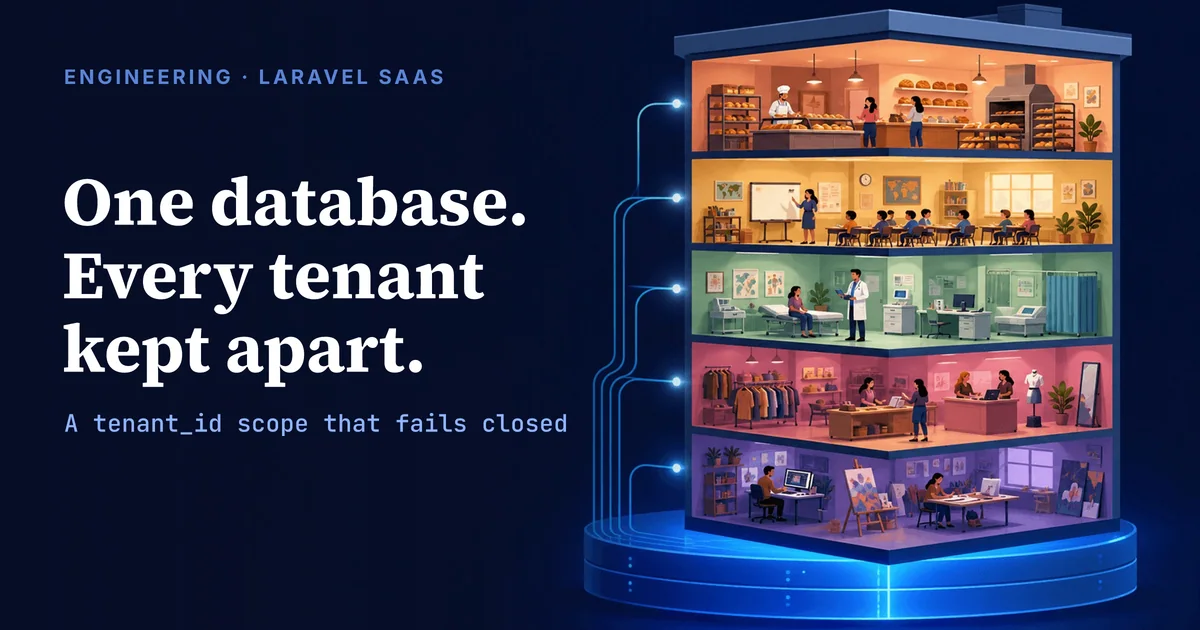
Single database or one per tenant? A production-tested multi-tenant setup for Laravel SaaS: global scopes, tenant resolution, queues and the mistakes to avoid.
On this page 5 sections
Every SaaS I’ve built, from the POS to Oxygen LMS, has had to answer the same question on day one: how do we keep each customer’s data separate? Get it wrong and you either leak data between customers or drown in operational complexity.
The three options#
| Strategy | Isolation | Ops cost | Good for |
|---|---|---|---|
Shared DB, tenant_id column | Logical | Low | Most early-stage SaaS |
| Schema per tenant | Medium | Medium | Postgres shops, moderate tenant counts |
| Database per tenant | Strong | High | Enterprise, compliance, noisy neighbours |
Start with a shared database and a tenant_id column
Context. Small team, hundreds of tenants expected, low budget, fast iteration needed.
Decision. One MySQL database; every tenant-owned table has an indexed tenant_id; isolation enforced in the application layer with a global scope.
Consequences. Cheap and simple. The cost is discipline: every query must be scoped, so we enforce it automatically and test it.
Project layout#
- app/
- Tenancy/
- TenantContext.php
- BelongsToTenant.php
- TenantScope.php
- Http/Middleware/
- ResolveTenant.php
- Models/
- Tenant.php
- Student.php
- Tenancy/
- database/migrations/
- tests/Feature/
- TenantIsolationTest.php
Step by step#
Hold the current tenant in one place
A tiny singleton that knows who the current tenant is. Everything else asks it.
app/Tenancy/TenantContext.php final class TenantContext { private ?Tenant $tenant = null; public function set(Tenant $tenant): void { $this->tenant = $tenant; } public function get(): ?Tenant { return $this->tenant; } public function id(): ?int { return $this->tenant?->id; } }Register it as a singleton in a service provider:
$this->app->singleton(TenantContext::class);Resolve the tenant from the request
I use subdomains (
school-a.oxygenlms.com). Resolve once per request in middleware and fail closed if the tenant is unknown.app/Http/Middleware/ResolveTenant.php public function handle(Request $request, Closure $next) { $sub = explode('.', $request->getHost())[0]; $tenant = Tenant::query() ->where('subdomain', $sub) ->where('active', true) ->firstOrFail(); // fail closed: never fall back to "no tenant" app(TenantContext::class)->set($tenant); return $next($request); }Scope every query automatically
A global scope plus a trait means developers can’t forget the
where tenant_id = ?clause.trait BelongsToTenant { protected static function bootBelongsToTenant(): void { static::addGlobalScope(new TenantScope); static::creating(function ($model) { $model->tenant_id ??= app(TenantContext::class)->id() ?? throw new LogicException('No tenant in context'); }); } }final class TenantScope implements Scope { public function apply(Builder $builder, Model $model): void { $id = app(TenantContext::class)->id(); // Fail closed: no tenant means no rows, never all rows. $builder->where($model->qualifyColumn('tenant_id'), $id ?? 0); } }class Student extends Model { use BelongsToTenant; }Carry the tenant into queued jobs
Queues are where tenancy bugs hide. A job runs in a different process, so the context is empty. Store the tenant ID on the job and restore it before
handle().app/Jobs/SendFeeReminders.php class SendFeeReminders implements ShouldQueue { public function __construct(public int $tenantId) {} public function handle(TenantContext $ctx): void { $ctx->set(Tenant::findOrFail($this->tenantId)); // ... scoped queries are safe from here } }Prove isolation with a test
This is the most important test in the codebase. It runs on every push.
tests/Feature/TenantIsolationTest.php it('never returns another tenant’s students', function () { [$a, $b] = Tenant::factory()->count(2)->create(); Student::factory()->for($b)->create(); app(TenantContext::class)->set($a); expect(Student::count())->toBe(0); });
Indexes matter more than you think#
With a shared database, almost every query filters by tenant_id first. Put it at the front of your composite indexes:
-- good: matches "where tenant_id = ? and class_id = ? order by name"
CREATE INDEX students_tenant_class_name ON students (tenant_id, class_id, name);
When I’d choose a database per tenant#
Signals that it’s time to move to stronger isolation
- A customer contract requires physical data separation or data residency.
- One tenant is so large that it slows everyone else down (noisy neighbour).
- You need per-tenant backups and restores as a product feature.
Because every model already carries tenant_id, moving a large tenant to its own database later is a data migration, not a rewrite.
Questions readers ask
Should a Laravel SaaS use one database or a database per tenant?
For most early SaaS products, one database with a tenant_id column enforced by a global scope is simpler to run, cheaper to host and easy to migrate later.
When should you move to a database per tenant?
When a contract requires physical separation or data residency, when one tenant is large enough to slow everyone else down, or when per-tenant backups and restores are a product feature.
Where do multi-tenant data leaks usually happen?
In queued jobs and raw queries, where the global scope or tenant context may be missing. Fail closed, so no tenant means no data, and test those paths explicitly.